Skip to content



Most cold warehouses are not short of heat but they are heating the wrong part of the building. Warm air from heaters rises into the roof void and escapes every time a roller door opens. That leaves the pick face and production line below the guideline while the gas or electricity bill climbs. This guide covers three things: what the law and HSE actually require, why large buildings miss the 16°C minimum at floor level, and how zonal infrared heating keeps the people inside comfortable and compliant.
Key facts
| Rule | What it says | Source |
|---|---|---|
| Legal duty | Indoor workplace temperature must be “reasonable” during working hours | Workplace Regulations 1992, reg. 7 |
| Minimum for most work | Should normally be at least 16°C | HSE L24, para. 61 |
| Minimum for physical work | At least 13°C where much of the work involves rigorous physical effort | HSE L24, para. 61 |
| Maximum | There is no legal maximum working temperature | HSE |
| Thermometers | Employers must provide enough thermometers for people to check the temperature | Workplace Regulations 1992, reg. 7 |
| Where 16°C is not practical | Local heating first, then protective clothing, rest facilities and task rotation | HSE L24, paras. 65 and 69 |
What is the minimum working temperature in the UK?
The minimum working temperature in the UK should normally be at least 16°C for indoor work, or at least 13°C where much of the work involves rigorous physical effort. Both figures come from paragraph 61 of HSE’s Approved Code of Practice L24. L24 supports the Workplace (Health, Safety and Welfare) Regulations 1992.
The 1992 Regulations cover England, Scotland and Wales. Northern Ireland has the same temperature rule under regulation 7 of the Workplace (Health, Safety and Welfare) Regulations (Northern Ireland) 1993.
Which figure applies depends on the job, not the building. A forklift driver or a packer at a bench generates little body heat, so the 16°C guideline applies. A team manually loading heavy stock may fall under the 13°C figure.
Treat 16°C as a floor rather than a target. L24 notes that the minimums may not give reasonable comfort once air movement and humidity are taken into account. That is exactly the situation in a draughty warehouse.
Is 16°C a legal requirement?
The 16°C figure is not written into law as a fixed limit. The legal duty, in regulation 7, is that the temperature in indoor workplaces must be “reasonable” during working hours.
The 16°C and 13°C figures carry weight because they sit in an Approved Code of Practice. L24 explains that an employer who does not follow the Code must be able to show they met the law in some other way. In practice, falling below 16°C without a documented reason and a plan is hard to defend.
Two other duties apply alongside regulation 7:
- Risk assessment. HSE expects temperature to be covered under the Management of Health and Safety at Work Regulations 1999, with workers or their representatives consulted.
- Thermometers. Regulation 7 requires enough thermometers for people to check the temperature. L24 (paragraph 68) says they should not hang in front of windows or next to a heat source.
There is no legal maximum working temperature in the UK. HSE treats heat as a hazard to be risk-assessed instead.
Does the minimum apply to loading bays and cold stores?
The 16°C guideline does not apply in the same way to areas that must stay open to the outside or cold for the product. Paragraph 62 of L24 says the temperature in these areas should be kept as close to the minimum as is practical.
That does not remove the duty of care. L24 sets out what to do next, in this order:
- Reduce the cold area. Enclose or insulate chilled product and keep chilled zones as small as possible (paragraph 63).
- Add local heating. Where a comfortable temperature cannot be reached throughout a workroom, local heating should be provided (paragraph 65).
- Protect the people. Where local heating still does not give reasonable comfort, provide suitable protective clothing and rest facilities. Use task rotation to limit exposure (paragraph 69).
For a loading bay, that usually means radiant heaters over the marshalling area and dispatch desk, not trying to warm the air beside an open roller door. For a cold store, heat the anteroom, break area and paperwork stations. Never heat inside the chilled space itself.
Why do warehouses and factories struggle to reach 16°C at floor level?
Large buildings miss the 16°C minimum at floor level because conventional heaters warm the air, and warm air does not stay where people work. Five factors usually combine:
- Stratification. Heated air rises. In a high-bay warehouse the warmest air collects under the roof, while the pick face and benches stay cold.
- Open doors. Every time a roller shutter opens, heated air is replaced by outside air. HSE notes that small air movements in cold conditions are felt as draughts.
- Extraction. Dust and fume extraction in factories removes heated air along with the contaminant.
- Low-activity roles. Forklift drivers, packers and quality checkers produce little body heat, so they feel the cold first.
- Volume versus headcount. A 5,000m² shed with 20 people in it is mostly empty air. Heating all of it to warm a few workstations is the costliest way to comply.

How does zonal infrared heating keep workstations warm?
Zonal infrared heating keeps workstations warm by heating the people and surfaces in a defined zone directly, not the air around them. It works like sunshine on a cold day: you feel warm in the sun even when the air is cold.
HSE’s own guidance backs the principle. Its page on thermal comfort factors states that “radiant temperature has a greater influence than air temperature on how we lose or gain heat to the environment”. It also says air temperature alone “is not a valid or accurate indicator of thermal comfort”.
SunSwitch heaters use HeatLogik®, SunSwitch’s proprietary shortwave infrared technology. HeatLogik heaters give warmth within seconds of switching on and need no pre-heating. Air movement from open doors or extraction does not carry the heat away. Because they are electric, they produce no combustion products. That keeps them clear of regulation 7’s ban on heating that releases harmful fumes.

Zonal infrared is also the “local heating” route L24 describes for workrooms that cannot be kept comfortable throughout. Each zone can be switched by timer, motion sensor or a central controller, so heat runs only where and when people are working.
| Warm-air or convection heating | Zonal shortwave infrared (HeatLogik) | |
|---|---|---|
| What it heats | The air in the whole building | People, floors and surfaces in a defined zone |
| Warm-up time | Needs pre-heating before the shift starts | Warmth within seconds of switching on |
| Effect of open doors | Heated air is lost and must be replaced | Little effect: radiant heat is not carried by air |
| Where the heat collects | Under the roof, through stratification | At working height, where people are |
| Control | Usually whole-building or large zones | Per heater or zone, by timer, PIR or controller |
| Combustion products | Gas units need flues and ventilation | None (electric) |
| Maintenance | Fans, burners and filters | No moving parts, only a replaceable element |
Infrared is not the answer for every building. It warms what it can “see”, so people at the edge of a heater’s coverage feel less warmth. It is also not designed to lift the air temperature of a whole building for stock or process reasons. Where that is the goal, a convection system or heat pump may suit better, sometimes alongside infrared at the workstations.
How to measure it fairly.
A standard thermometer measures air temperature only. To capture the radiant warmth staff actually feel, take readings at working height with a black-globe thermometer, which responds to radiant heat. Record both figures in your risk assessment.
Which SunSwitch heater suits which area?
The right heater depends on mounting height, the environment and how the area is used. The table below matches common warehouse and factory areas to SunSwitch ranges. The figures come from the SunSwitch Industrial Products Brochure (March 2026).
| Area | Range and example model | Coverage at mounting height | Floor temp. at 8°C ambient | IP rating |
|---|---|---|---|---|
| High-bay warehouse aisles and packing areas | Titan Super Power, EHTV3-60 (6.0kW) | 39m² at 4.0m | 25°C | IP55 |
| Factory workstations and production lines | Standard Industrial, V400/2V-40X5FM (4.0kW) | 25 to 30m² at 3.5m | 23°C | IPX5 |
| Workshops, wash bays and wet areas | Standard Industrial, V400/3V-60X5FM (6.0kW) | 39m² at 4.0m | 25°C | IPX5 |
| Dusty areas such as woodworking | Glass-fronted, V66/20 (2.0kW) | 20m² at 2.5m | 25°C | IP66 |
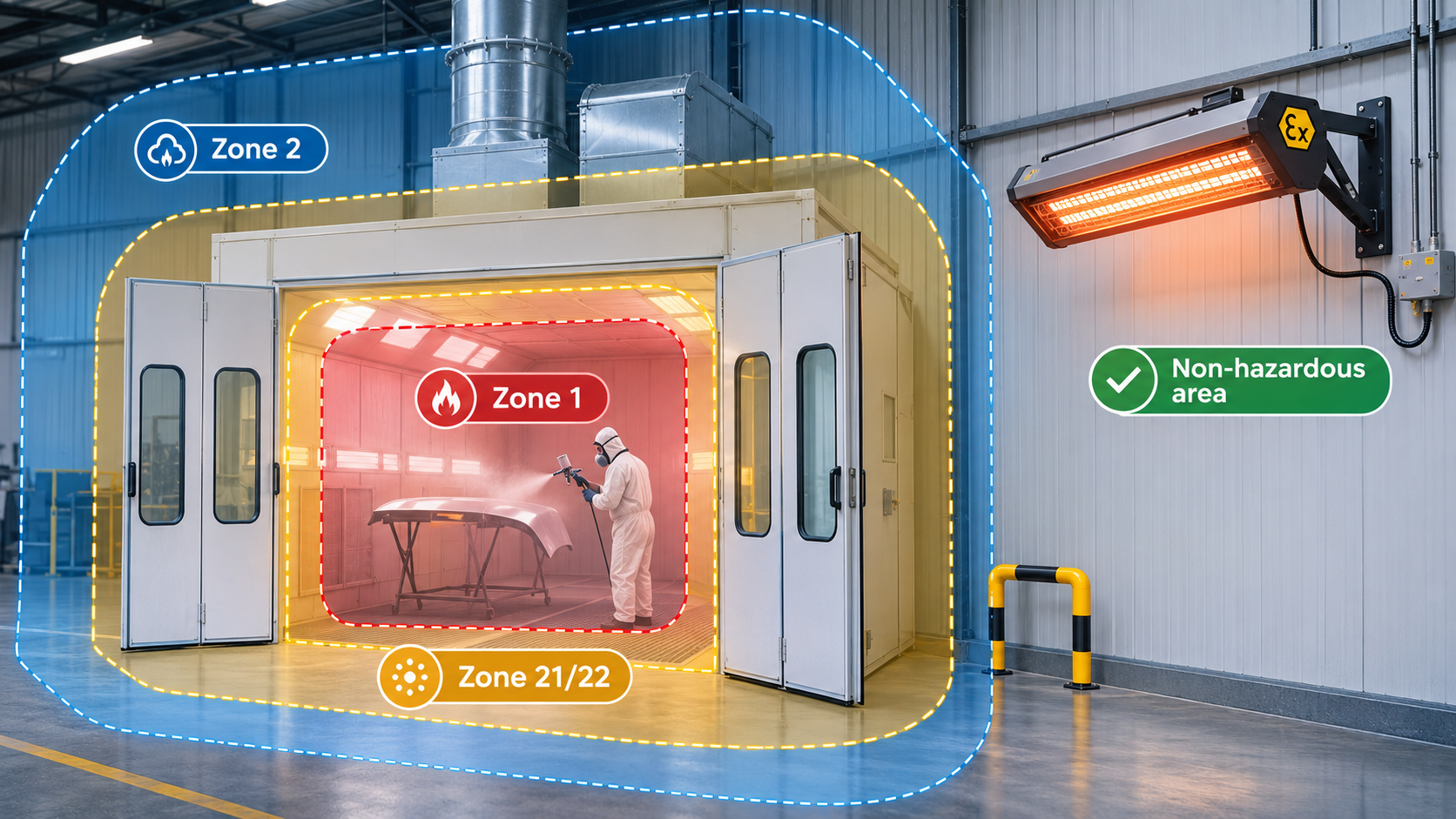
| Spray booths and ATEX Zone 2 or Zone 22 areas | ATEX approved, EHSAFE20VR (2.0kW) | 20m² at 2.5 to 3.0m | 25°C | IP66 |
| Single benches or areas that move | Mobile, V400F2 (1.5kW, plug-in) | 12 to 15m² heated area | Not stated | IPX5 |
All coverage and floor-temperature figures are indicative. They assume a 45° installation angle and an 8°C ambient temperature. Heat is emitted in a cone, so a person at the edge of the coverage area feels less warmth than one in the centre. See the full range of electric radiant heaters.
ATEX areas need certified equipment.
The EHSAFE20VR ATEX heater is Group II, Category 3G/3D, for Zone 2 (gas) and Zone 22 (dust) only. It must never be installed in Zones 0, 1, 20 or 21. Your zone classification should come from your DSEAR risk assessment.
Controls decide the running cost. SunSwitch controls and sensors keep heaters off when nobody is there:
- Loading bays and intermittent areas: SSPIR6 motion sensor, with a 5.0m detection range, an adjustable 1 to 60 minute on-time and a 5 to 25°C set point.
- Single benches: SSPB6 push-button timer, giving 1 to 60 minutes of heat per press.
- Multi-zone warehouses: STAR24 controller, running four 6.0kW channels at three heat levels on single- or three-phase supply.
How do you bring a cold site into compliance? Five steps
Bringing a cold warehouse or factory into line with the minimum working temperature takes five steps, from measurement to review.
- Measure where people work. Take readings at working height in each area at the start of shifts on the coldest days. Record air temperature and, where possible, a black-globe reading that captures radiant heat.
- Map who works where. List fixed workstations, routes and break areas, and when each is occupied. Note whether the work is sedentary (16°C) or physically demanding (13°C).
- Update the risk assessment. Consult staff and record any area where 16°C throughout is not practical, such as loading bays. Add the local heating, clothing and rest-break plan for each.
- Design heating zones. Size a heater or group of heaters for each occupied zone, matching mounting height and IP rating. For hazardous areas, match the ATEX classification too. SunSwitch offers a free site survey to map heater positions to your workstations.
- Control and review. Fit timers, motion sensors or zone controllers and re-measure after installation. Review the assessment every autumn before the heating season.

What should you do when staff say it is too cold?
When staff say it is too cold, check the temperature where they actually work and act on it the same day. HSE advises that workers should talk to their employer if the workplace temperature is not comfortable. A complaint is the start of the process, not a dispute.
HSE’s guidance on managing cold workplaces lists the immediate measures:
- Provide adequate heating, such as portable heaters, for occupied work areas.
- Reduce draughts while keeping adequate ventilation.
- Provide insulating floor coverings or suitable footwear where people stand on cold floors for long periods.
- Allow enough breaks for workers to get hot drinks or warm up in heated areas.
- Limit time in cold areas through job rotation or flexible working.
A plug-in mobile infrared heater can warm a bench or desk within minutes while you plan a permanent fix. Record the readings, the complaint and the action taken, so your risk assessment shows the problem was handled.
Frequently asked questions
What is the lowest temperature you can legally work in, in the UK?
UK law sets no fixed lowest temperature. The Workplace (Health, Safety and Welfare) Regulations 1992 require a “reasonable” temperature indoors. HSE’s Approved Code of Practice says that should normally be at least 16°C, or 13°C for work involving rigorous physical effort. An employer working below those figures needs a documented reason and a plan.
Does the minimum working temperature apply to warehouses?
Yes. The 16°C guideline applies to indoor workrooms, including warehouses and factories. Some areas must be open to the outside, such as loading bays, or kept cold for the product, such as cold stores. These should be kept as close to the minimum as is practical, with local heating, protective clothing and warm rest areas.
What is the minimum temperature for physical work?
The minimum is 13°C where much of the work involves rigorous physical effort, such as manual loading. Sedentary or light roles, including forklift driving, packing and quality checks, fall under the 16°C guideline because they generate little body heat.
Can staff refuse to work if it is too cold?
There is no set temperature at which work must automatically stop. HSE advises workers to raise the issue with their employer. The employer must then assess the risk and act, for example with local heating, extra breaks or suitable clothing. Recording the readings and actions protects both sides.
Is infrared heating a compliant way to heat a workplace?
Yes, when it is designed for the occupied areas. HSE’s L24 guidance calls for local heating where a workroom cannot be kept comfortable throughout. HSE also notes that radiant temperature has a greater influence on comfort than air temperature. Electric infrared also produces no combustion fumes.
Struggling to reach 16°C?
Book a free site survey
Warm, happy workers are productive workers. SunSwitch’s technical team can survey your warehouse or factory and map where your people work. They will then design a zonal infrared layout that brings each workstation up to a comfortable temperature without heating the roof.