Skip to content


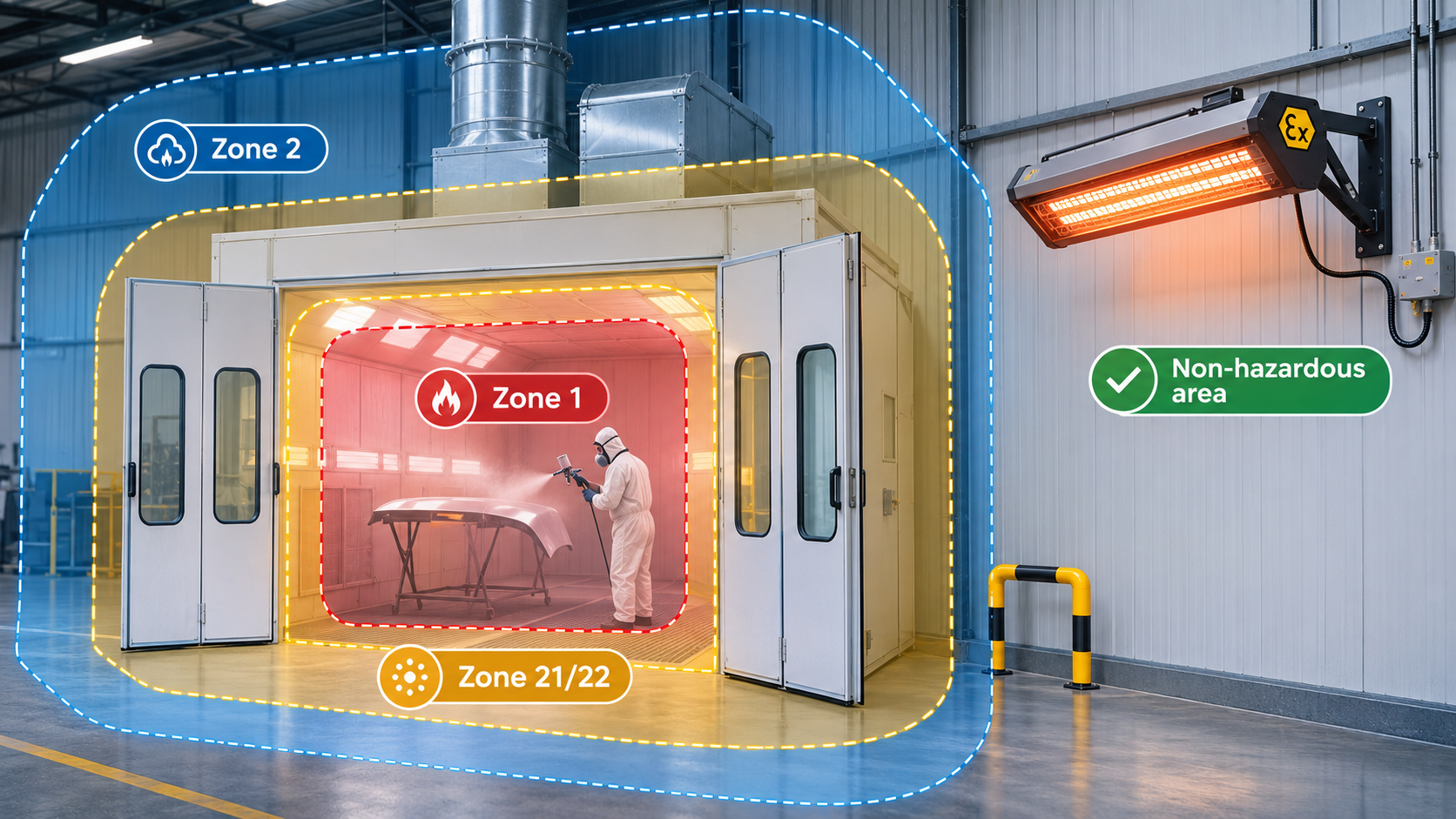
A heater that works in an ordinary warehouse is one of the most dangerous objects you can put in a spray booth. Its element runs hot enough to ignite solvent vapour or settled dust, and its wiring was never designed to keep a spark away from a flammable atmosphere. This guide covers four things: what each ATEX zone means, what DSEAR requires in the UK, why standard heaters fail the test, and what to check before you buy a certified one.
What are ATEX zones?
ATEX zones are areas of a workplace where an explosive atmosphere may occur. They are graded by how often and for how long the atmosphere is present. Gas, vapour and mist areas are Zones 0, 1 and 2, and combustible dust areas are Zones 20, 21 and 22. The definitions are set out in Schedule 2 of the Dangerous Substances and Explosive Atmospheres Regulations 2002 (DSEAR).
| Zone | Hazard | How often the explosive atmosphere is present | Equipment category allowed |
|---|---|---|---|
| Zone 0 | Gas, vapour or mist | Continuously, for long periods or frequently | Category 1 only |
| Zone 1 | Gas, vapour or mist | Likely to occur occasionally in normal operation | Category 1 or 2 |
| Zone 2 | Gas, vapour or mist | Not likely in normal operation; if it occurs, only for a short period | Category 1, 2 or 3 |
| Zone 20 | Dust cloud | Continuously, for long periods or frequently | Category 1 only |
| Zone 21 | Dust cloud | Likely to occur occasionally in normal operation | Category 1 or 2 |
| Zone 22 | Dust cloud | Not likely in normal operation; if it occurs, only for a short period | Category 1, 2 or 3 |
Sources: DSEAR Schedule 2 (zone definitions) and Schedule 3 (equipment categories).
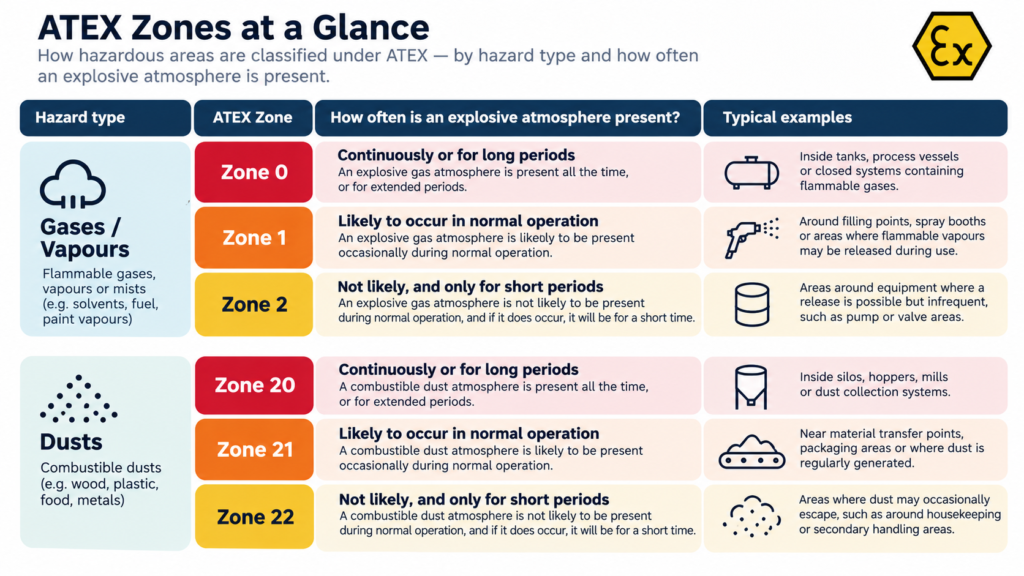
Dust does not have to be airborne to count. Schedule 2 states that layers, deposits and heaps of combustible dust must be treated like any other source that can form an explosive atmosphere. A dusty beam above a sanding line matters as much as the cloud at the machine.
“ATEX” comes from the European directives these rules are based on. In Great Britain, the workplace rules sit in DSEAR, and the rules for equipment sit in the Equipment and Protective Systems Intended for Use in Potentially Explosive Atmospheres Regulations 2016.
How does DSEAR apply in the UK?
DSEAR requires employers and the self-employed to control the risk of fire and explosion from dangerous substances at work. HSE lists those substances as including solvents, paints, varnishes, flammable gases such as LPG, dusts from machining and sanding, and dusts from foodstuffs. Northern Ireland has its own equivalent regulations.
Under regulation 7 and HSE’s guidance, an employer with an explosive atmosphere must:
- Assess the risk. Identify the dangerous substances present and how they could ignite.
- Eliminate or control it. Remove the substance where possible, or reduce and contain it.
- Classify hazardous areas into zones. Do this using the Schedule 2 definitions.
- Select suitable equipment. Equipment in each zone must meet the Schedule 3 categories, unless the risk assessment finds otherwise.
- Mark the entry points. Where necessary, use the triangular yellow “Ex” warning sign set out in Schedule 4.
- Verify before first use. A person competent in explosion protection must confirm the overall explosion safety of the workplace.
- Provide anti-static clothing. Workers in hazardous places need suitable clothing, plus information, training and emergency arrangements.
Certified equipment carries the “Ex” symbol and a conformity mark. In Great Britain, the government confirmed in January 2024 that CE marking for this type of equipment will continue to be recognised indefinitely, alongside UKCA.
Why do standard industrial heaters fail in ATEX zones?
Standard industrial heaters fail in ATEX zones because nothing in their design stops them igniting the atmosphere around them, and they carry no certification to prove otherwise. Four problems combine:
- Hot surfaces with no declared limit. A shortwave element and its reflector run very hot. A standard heater has no temperature class, so nobody can show its surface stays below the ignition temperature of the gas or dust in the room.
- Exposed electrical connections. Terminals, internal wiring and cable entries are built for ordinary areas. A loose connection or switching arc inside an uncertified enclosure is an ignition source.
- Dust gets in and settles. Dust that collects on a hot reflector or inside the housing can smoulder, and DSEAR treats those layers as an explosion source in their own right.
- No equipment category. DSEAR Schedule 3 requires Category 1, 2 or 3 equipment in zones, so an uncategorised heater fails selection before anyone looks at its specification.
A high IP rating does not solve this. IP ratings measure protection against dust and water getting in. They say nothing about surface temperature or spark containment. SunSwitch’s own standard heaters (IPX5) and Titan range (IP55) are built for non-hazardous areas and must not be used in any ATEX zone.
Standard industrial heater vs ATEX heater: how do they compare?
The difference between a standard industrial heater and an ATEX heater is the certification, the declared temperature limits and the zones it may legally serve. The comparison below uses two SunSwitch heaters from the Industrial Products Brochure (March 2026).
| Standard Industrial heater (V400/2V-30X5FM) | ATEX approved heater (EHSAFE20VR) | |
|---|---|---|
| Power | 3.0kW | 2.0kW |
| ATEX certification | None | Group II, Category 3G (gas) and 3D (dust) |
| Permitted zones | Non-hazardous areas only | Zone 2 and Zone 22 |
| Gas group | Not rated | IIC (covers IIA and IIB) |
| Dust group | Not rated | IIIC conductive dust (covers IIIA and IIIB) |
| Maximum surface temperature | Not declared | T2 (300°C) for gas; 290°C for dust |
| IP rating | IPX5 | IP66 |
| Certified ambient range | Not applicable | −5°C to +25°C |
| Standards | Not applicable | ATEX Directive 2014/34/EU, EN 60079-0, EN 60079-15, EN 60079-31 |
| Price (ex VAT, March 2026) | £355 | £1,598 |
The higher price pays for the certification route, the protected enclosure and the declared limits. Those are what let a DSEAR assessor sign the heater off for a Zone 2 or Zone 22 area.
How do you read an ATEX heater marking?
An ATEX marking tells you which atmosphere, zone and temperature limit a heater is certified for. The SunSwitch EHSAFE20VR carries two markings, one for gas and one for dust.
Gas: Ex II 3G Ex nR IIC T2 Gc
- Ex shows the equipment is certified for explosive atmospheres.
- II means Group II: surface industries, not mining.
- 3G means Category 3 for gas, so the heater is suitable for Zone 2.
- Ex nR is the protection method: a restricted-breathing enclosure that limits how much gas can enter.
- IIC is the gas group. Hydrogen is the reference gas, and IIC also covers IIA and IIB gases.
- T2 means the maximum surface temperature is 300°C.
- Gc is the equipment protection level for Zone 2.
Dust: Ex II 3D Ex tc IIIC T290°C Dc
- 3D means Category 3 for dust, so the heater is suitable for Zone 22.
- Ex tc is the protection method: protection by enclosure.
- IIIC is the dust group, covering conductive dust as well as IIIA flyings and IIIB non-conductive dust.
- T290°C means the maximum surface temperature is 290°C.
- Dc is the equipment protection level for Zone 22.
What safety limits apply to heaters in gas and dust zones?
Every ATEX heater has a maximum surface temperature, and it must stay below the ignition temperature of the substance in your zone. Gas equipment is grouped into six temperature classes:
| Temperature class | Maximum surface temperature |
|---|---|
| T1 | 450°C |
| T2 | 300°C |
| T3 | 200°C |
| T4 | 135°C |
| T5 | 100°C |
| T6 | 85°C |
Source: Atexor ATEX guidelines, based on EN 60079-0.
For gas zones: a T2 heater suits only gases and vapours whose auto-ignition temperature is above 300°C. Check the safety data sheet for every solvent used in the area.
For dust zones: the dust safety margin is wider. Under IEC/EN 60079-14, equipment surface temperature must not exceed the lower of two figures:
- two-thirds of the dust cloud’s ignition temperature
- the ignition temperature of a 5mm dust layer, minus 75K
For the EHSAFE20VR, rated at 290°C, that means your dust needs a cloud ignition temperature of at least 435°C and a 5mm layer ignition temperature of at least 365°C. Thicker layers need a tighter margin. If your dust test data shows lower figures, this heater is not suitable for that area, and your DSEAR assessor should advise on alternatives.
Ambient temperature matters too. The EHSAFE20VR is certified for ambient temperatures from −5°C to +25°C. An area that runs hotter than 25°C, for example during curing, is outside its certification.
How do you choose and install a heater for an ATEX zone?
Choosing a heater for an ATEX zone starts with your DSEAR assessment, not the product catalogue. Work through these five steps:
- Get the zone drawing. Your DSEAR risk assessment should show every zone and its boundaries, along with the substances and their ignition data.
- Match category, group and temperature. The heater’s category must suit the zone (Category 3 for Zone 2 or 22). Its gas or dust group must cover your substance, and its temperature limit must clear the safety margins above.
- Check where the heater will sit. Inside some spray booths, the area is classified Zone 1 while spraying. A Category 3 heater can only go in the Zone 2 or non-hazardous part of the room, aimed at the work area.
- Install to the standard. Use an installer competent in hazardous-area work, following BS EN 60079-14, with suitable cable glands and isolation.
- Verify, inspect and record. Have explosion safety verified before first use, as regulation 7 requires. Then inspect periodically to BS EN 60079-17 and keep the records with your DSEAR file.

The EHSAFE20VR mounts at 2.5 to 3.0m at a 45° angle and covers about 20m². In the brochure’s tests at an 8°C ambient temperature, it reaches a floor temperature of 25°C. That makes it suitable for spot-heating a workstation or, in groups, a larger dusty area. A 1.5kW version and a 110V version are made to order.
What are the ATEX zones?
There are six ATEX zones. Zones 0, 1 and 2 cover gas, vapour and mist, and Zones 20, 21 and 22 cover combustible dust. The lower the number, the more often an explosive atmosphere is present, so Zone 0 and Zone 20 are the most hazardous.
Can I use a normal heater in a Zone 2 area?
No. DSEAR requires equipment in a Zone 2 area to be Category 1, 2 or 3, unless the risk assessment finds otherwise. A standard heater has no category or declared surface temperature, so it cannot be shown to be safe in a flammable atmosphere.
What does T2 mean on an ATEX heater?
T2 is a temperature class meaning the heater’s maximum surface temperature is 300°C. It is only suitable for gases and vapours with an auto-ignition temperature above 300°C.
Is an IP66 heater safe for ATEX zones?
Not on its own. IP66 means the enclosure is dust-tight and protected against powerful water jets. It does not limit surface temperature or contain sparks, which is what ATEX certification covers.
Who decides which ATEX zone an area is?
The employer does, through the DSEAR risk assessment, usually with help from a competent person in explosion protection. The zone drawing produced from that assessment is what you use to select equipment.
Working in Zone 2 or Zone 22?
Shop ATEX heaters or get a quote
The SunSwitch EHSAFE20VR is certified for Zone 2 gas and Zone 22 dust areas, including conductive dust. Send us your zone drawing and our technical team will confirm suitability and plan heater positions for your booth or workstation.